



We study the mechanisms driving skin cancer progression, immune interactions, and therapeutic resistance. Our research focuses on melanoma, including rare subtypes such as acral and uveal melanoma, as well as squamous cell carcinoma (SCC), basal cell carcinoma (BCC), and cutaneous lymphomas. Using single-cell, spatial, and multiomic approaches, we investigate tumor ecosystems and treatment response across large patient-derived datasets generated within our group and through collaborative studies. Through the close integration of computational, experimental, and clinical research – including cutting-edge perturbation systems – we aim to advance translational cancer research and precision oncology.
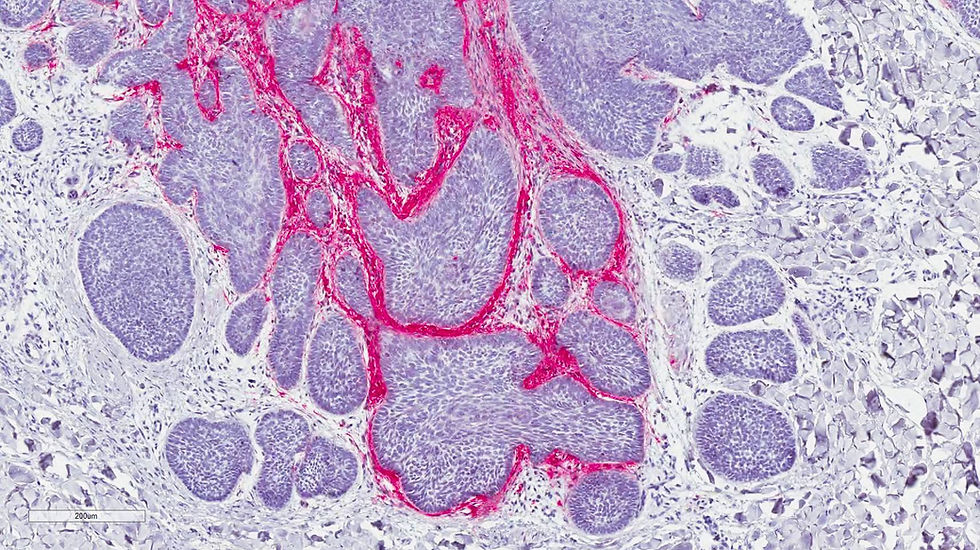
Basal cell carcinoma microenvironment stained with an antibody for collagen type X.
Tumor Microenvironment
The tumor microenvironment plays a critical role in cancer progression, therapeutic response, and immune surveillance. Our research aims to decipher the complex interactions between malignant cells and their surrounding ecosystem, including immune cells, stromal cells, and extracellular signaling networks.
We have developed methodologies to study how melanoma cells communicate with their microenvironment through extracellular vesicles, which can influence immune responses and promote tumor progression (García-Silva et al. Nature Cancer, 2021; Lattmann et al., Cancers, 2022; Lattmann et al., STAR Protocols, 2023). Using single-cell multiomic and spatial transcriptomic technologies, we have mapped tumor–immune interactions across melanoma, cutaneous lymphomas, and other skin cancers to identify cellular programs associated with disease progression and treatment response (Lischetti et al., Communications Biology, 2023; Hermes et al., 2025).
We have also characterized the stromal compartment of tumors, with a particular focus on immune populations and cancer-associated fibroblasts (CAFs) across different histological subtypes of basal cell carcinoma (Dommann et al., Journal of Cutaneous Pathology, 2026; Esposito et al., British Journal of Dermatology, 2024). Among our current projects, we investigate the molecular organization of tertiary lymphoid structures (TLS) and their interactions with melanoma cells to better understand their role in anti-tumor immunity and response to immunotherapy.

Multiplex immunohistochemistry image of a cutaneous melanoma lymph node metastasis. Tumor cells are shown in pink (S100⁺/MelanA⁺), and B cells are shown in green.
Cancer Vulnerabilities & Disease Evolution
Cancer progression is driven by the acquisition of cellular states that enable malignant cells to survive, adapt, and evade therapeutic intervention. Our research aims to identify molecular dependencies and vulnerabilities that can be exploited therapeutically, while uncovering the mechanisms that drive disease initiation, progression, and treatment resistance.
In cutaneous melanoma, we have investigated how rewiring of cancer signaling and metabolic adaptation enable cancer cells to survive therapeutic pressure and acquire resistant phenotypes, revealing mechanisms of disease progression and treatment failure (Dzung et al., Journal of Investigative Dermatology, 2022; Eichhoff et al., Cancer Research, 2023, Cerezo-Wallis Nature Medicine, 2020).
Using functional genomic and multiomic approaches, we have identified genetic and non-genetic dependencies across cancers. This includes the discovery and validation of synthetic lethal vulnerabilities in uveal melanoma that represent promising therapeutic opportunities (Elbatsh et al., Nature Cancer, 2024). A continuation of this project includes a comprehensive single-cell and spatial analysis of uveal melanoma and the screening of small-molecules to provide novel compounds for this high-medical need malignancy.
We also study the earliest stages of skin cancer development by characterizing premalignant cell states and evolutionary trajectories in actinic keratosis and cutaneous squamous cell carcinoma, with the goal of understanding how malignant programs emerge during tumor initiation (Staeger et al., 2026). In parallel, we investigate malignant cell-state transitions, epigenetic adaptation, and mechanisms of therapy resistance in cutaneous T-cell lymphoma. By integrating single-cell multiomics, spatial profiling, and functional approaches, we seek to understand how distinct tumor populations contribute to disease progression and treatment response.

Precision Medicine, Biobanking & Clinical Cohorts
Advances in precision oncology depend on the availability of well-annotated clinical cohorts, high-quality biospecimens, and technologies that enable comprehensive characterization of tumors and their microenvironment. Our research integrates clinical data, biobanking, and multiomic profiling to support translational cancer research and personalized treatment strategies.
We have developed innovative approaches for label-free analysis of cells and circulating biomarkers, enabling scalable and minimally invasive patient monitoring (Lattmann et al., Cell Mol Life Sci. 2024 ). As part of the Swiss Personalized Oncology initiative and Tumor Profiler, we contribute to the generation and integration of multiomic tumor profiles to improve patient stratification and therapeutic decision-making (Irmisch et al., Cancer Cell, 2021).
In parallel, we established clinically annotated dermatology biobanks, including workflows for the collection and preservation of viable live-frozen tumor tissues. These resources support downstream single-cell, spatial, and functional studies, enabling biomarker discovery and accelerating precision oncology research (Restivo et al., Communications Biology, 2022).

Mitochondria visualized in a melanoma cell line derived from therapy resistant patient.
Translational Oncology and Therapeutics
Understanding how cancer therapies affect both tumor cells and their microenvironment is essential for developing more effective treatments. Our research focuses on translating mechanistic insights into novel therapeutic strategies for skin cancers.
We have investigated emerging immunotherapies, including cytokine-armed T-cell therapies for advanced melanoma and oncolytic virotherapy (T-VEC) for cutaneous lymphomas (Ramelyte et al., Cancer Cell, 2021). We use healthy skin as a model to study the on-target, off-tumor effects of cancer immunotherapies, including tebentafusp in uveal melanoma patients, to better understand treatment efficacy and immune-related adverse events (Staeger et al., JCI, 2025). Furthermore, we elucidated the mechanisms underlying immunotherapy-associated toxicities and have identified a potential role for type III CD4+ T cells in adverse event development, providing proof-of-principle evidence for IL-17A blockade as a therapeutic strategy (Dimitriou et al., Nature Cancer, 2024).